7. Stumbling over Words and Ideas
– and, with some luck, finding something you’ve never thought of before

It may sound contemporary, but this very movement – turning our gaze inward toward our own ways of feeling, thinking, and speaking – does not begin with us. The first who seriously made us turn our attention in toward ourselves and our conceptual world was Heraclitus, the so-called “Obscure One” from Ephesus. He got it all going – a bit roughly at first – by starting to file away at language, at the building blocks we use to construct our worlds, both inner and outer.
An old anecdote tells us that when Euripides asks Socrates whether he has read the old Heraclitus, Socrates replies: “What I have understood is excellent, and I am sure that what I have not understood is just as good. But it would take a diver from Delos to bring it up.”
Obscure or not, Heraclitus in any case struck the tone for a series of questions that many thinkers have wrestled with ever since. He drew our attention to the vast linguistic terrain we are able to wander in – and thus he was also the first to try to explain just how deeply this language is woven into our lives.
But as the story also goes, in the end he withdrew and headed up into the mountains, tired of people’s lack of understanding, and lived there on herbs until he developed dropsy. When he then returned to the city and the physicians could not help him, he is said to have tried to cure himself by having his body covered in dung in a cowshed – after which he died. This story, however, we should probably take it with a pinch of salt.
After his death it was, alongside the Cratylus mentioned by Plato, above all Protagoras who came to inherit the old man’s legacy. In particular, it was the idea of panta rhei – that everything is in motion – which came to form the foundation on which large parts of the sophistic generation built; not as a cosmology, but rather as an understanding of how human beings pick up shards of reality and make them their own.
They also realized how, on that basis, others can be influenced by way of language itself – an idea which Plato later claimed was the very foundation of what he called Protagoras’ secret doctrine.
That everything was in motion was, however, far from self-evident – there arose, rather, a certain resistance from a group that would later come to call themselves philosophers, in order to set themselves apart from the earlier thinkers who were merely sophoi, so to speak, that is, knowledgeable people.
Among others, the philosopher Parmenides then chose instead to scrap the whole problem by arguing that this thing we call movement does not in fact exist – that it is a distorted experience, an illusion, nothing but a fantasy.
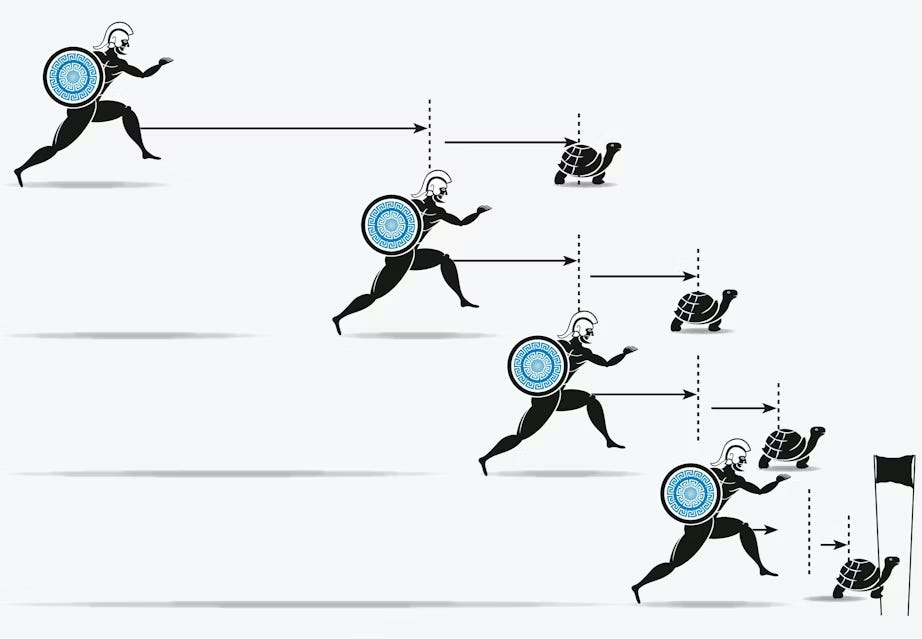
His close associate Zeno would then further hone the arguments, which primarily reach us through the paradoxes of Achilles and the tortoise, and of the flying arrow.
In the story of Achilles and the tortoise, it was claimed that Achilles would never be able to catch up with the tortoise if the latter were given a head start. The reasoning went as follows: once Achilles has covered the first stretch, the tortoise, as a matter of strict logic, must already have moved a bit further ahead, and once Achilles has covered that stretch as well, the tortoise must in turn have moved yet another bit – ad infinitum, which means that Achilles can never pass it. And the logic here is, of course, impeccable.
And in the example of the flying arrow, Zeno reasoned as follows: an arrow in motion through the air must, in each individual moment, occupy a space exactly as large as the arrow itself – in other words, it must be located at a determinate place, as if it were at rest. But if the arrow is at rest in every single moment, then it cannot move at all. Movement therefore does not exist. Crystal clear.

The contradictions that these examples seem to reveal were, according to this line of thought, not signs that the theory was wrong, but rather evidence that movement must be illusory and arises mainly in the world of the senses through our perceptions, in an act of phantasia – that which shows itself.
Here, a first crack runs right through our way of thinking and will come to divide our world. The philosophical tradition which, broadly speaking, begins with Parmenides, Zeno and Plato was a strong – one might even say desperate – reaction against what Heraclitus and later Protagoras had laid down as a foundation: namely, that it is primarily our concepts that are stable, not the reality they attempt to describe, and that logic is therefore fully reliable only within a closed system.
Either you follow Parmenides and Plato and think of truth as something motionless, beyond our senses. Or you stay with Heraclitus and Protagoras and see the world as fluid and our concepts as provisional attempts to keep up.
In what follows, I naturally lean toward the latter line – and then the question is no longer what truth “is” once and for all, but how we move within the flow and learn to grasp the right moments.
This is the crux with the words that build our languages, our sentences – our world. They are a bit blunt, somewhat flattened, and if we follow them strictly to the letter we easily end up in logical paradoxes and black-and-white absurdities.
We all know, moreover, that there are things that are good and things that are bad. But of course there are also things that are good in some situations but bad in others – something Heraclitus clearly found it urgent to draw our attention to. He therefore says: “Sea is the purest and the foulest water: for fish it is drinkable and life-giving, for humans undrinkable and deadly.”
If we lift our gaze from the water itself and the question of what is drinkable, and instead look to the structural point of what he is saying, we can take this to mean that rational thought, logic, is well suited when it comes to analysing linguistic statements – but less suited when it comes to understanding real-world conditions.
Whenever we use words, they always appear within a domain that also determines how they are to be interpreted; they each have a place in a linguistic landscape, a particular subject area or a specific situation – something we might call a topos, in order to connect to the sophists and their rhetoric. In classical rhetoric, a topos is precisely a “place” to which one goes to fetch arguments – and topoi are the typical topics, perspectives and problem-framings that become available within that particular linguistic terrain.
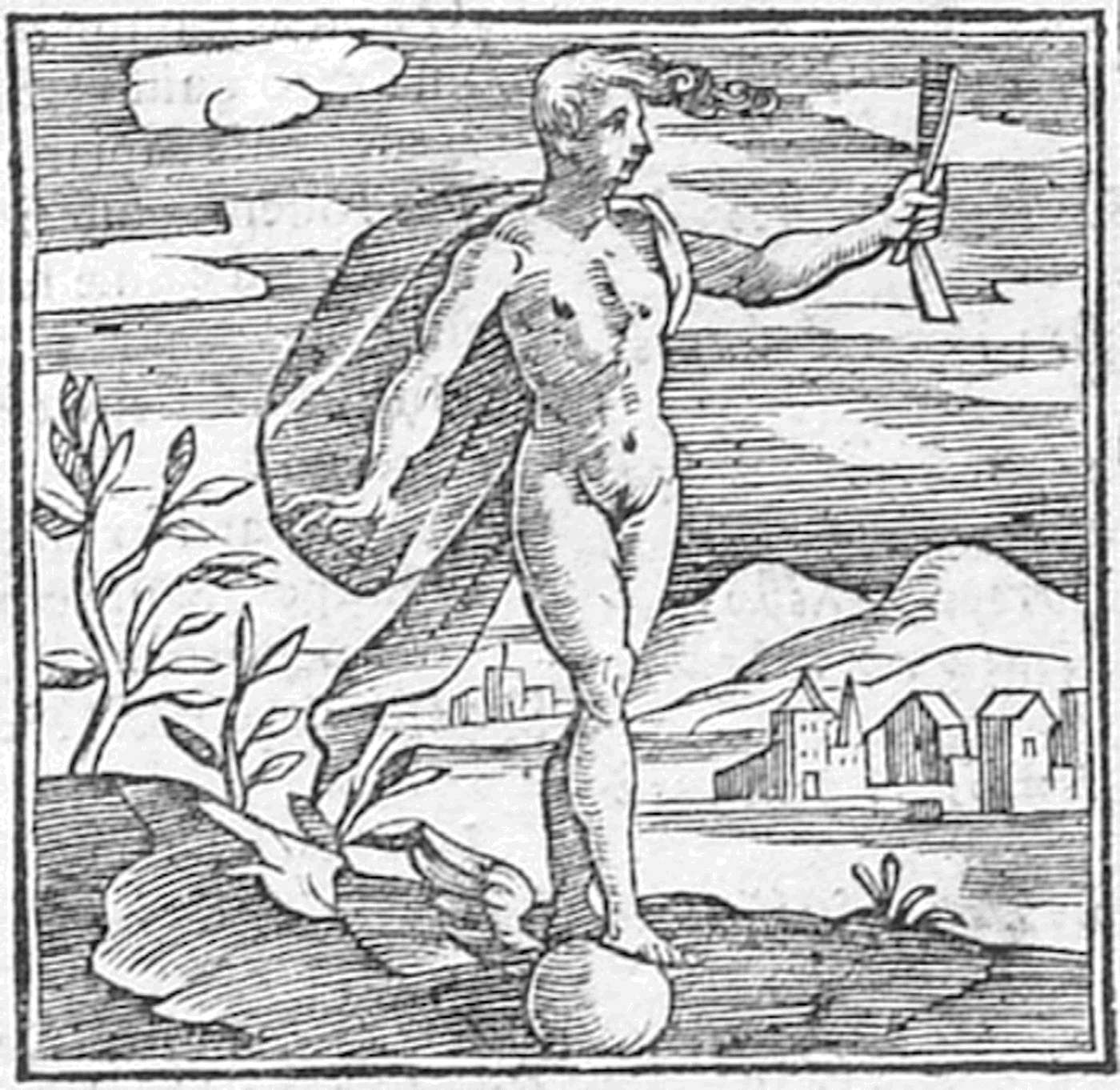
To think, say and act rightly requires a prior understanding of where one finds oneself and of the current situation, together with a sense of proper timing – a feel for when the moment is right – what the sophists called kairos, the ability to seize the opportunity in mid-flight.
Kairos, or Caerus in Latin, is the spirit of fleeting time in ancient Greece. He is usually depicted with a razor in his hand because he is so sharp. He stands on tiptoe since he is always on the move, and he is often shown with small wings attached to his back. His hair, or horse-tail, hangs down over his face, while his neck is bare. The myth thereby wishes to say that you can only get a grip him as he approaches – never once he has passed.
There are reports that Protagoras wrote a book with the title Kairos. In the work of his contemporary Gorgias, and later among those who developed classical rhetoric, the concept would eventually become central.
The sophist Isocrates (436–338) describes knowledgeable people, among other things, as those “who deal well with the circumstances that arise every day, and who possess a judgement that is accurate in relation to a situation as it unfolds and who seldom miss an opportunity to act forcefully.” Something we might today describe as acting with agency – or simply as having gumption, the nerve and practical sense to act when it matters.
The most striking aspect of kairos here is its direct connection to the eternal flow, panta rhei. Every moment is something we can neither halt nor recreate – but according to the idea of kairos we can learn to seize the right opportunities before they fully present themselves. The question, of course, is how.
An important prerequisite for noticing when a right opportunity appears is above all the ability, in the moment, to see what is better rather than worse (hēttôn & krêittôn). Without that basis, one hardly knows what to choose – or which opportunity one should in fact reach out and grasp.
Here I will put a full stop. In the next, and final, part of this series I intend to gather together the qualities, methods and tools which, on the basis of the fragmentary sources we possess (and my own reading of them), can be attributed to Protagoras and the sophists – and try to sketch a brief synthesis in which we can see how they all converge and work together with the aim of making us just a little bit wiser.
To read the previous texts in this series on Protagoras and the sophists, please go to the main page. If you find these texts interesting, you could of course also make my day by taking out a free subscription.